|
More than ever, I am convinced that every neighbourhood
needs a garden exactly like the one I envision. The "Persian
Garden" can be the first of many. In a multicultural country
like Canada, what could be better than having each culture,
heritage, and community take full responsibility for one of
these gardens—from the very first step to its completion,
maintenance, and ongoing vitality?
I view this project as a golden gift from the City of
Toronto, Mayor Olivia Chow, and Councillor Lily Cheng.
Without them, it would be difficult to believe that "Little
Iran" would finally take shape and the Persian Garden would
be proposed. The rest is up to us—Iranians and non-Iranians
alike—to practice democracy in its simplest form as we bring
this urban space to life: “Learn, Teach, and Apply.”
The Persian Garden can serve as an environment much like a
school or a university; a physical tool to bring people of
diverse cultural backgrounds closer together as an extension
of social media. Our success or failure on this path will be
a true test of our willingness and readiness for peaceful
coexistence.
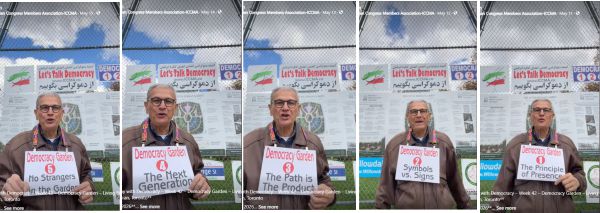
For the first time, I produced my “one-minute a day with
democracy” videos (Part 42) and Saturday afternoon videos
(Part 30) in English. In addition to sharing them across 80
Iranian groups across Canada, I posted them for the first
time in six English-speaking Willowdale Facebook groups.
Right from the start, I encountered obstacles I did not
expect. In this piece, I will address them briefly, and I
will dive into them more thoroughly in future writings.
Why a Daily One-Minute Video?
Different cultures observe different daily rituals, such as
the sounding of the “Azan” (Islamic call for prayer)
three times a day or the ringing of church
bells
every hour. Was the wisdom behind all of them not to create
a sense of awareness, presence, and awakening? Is the very
culture and practice of democracy not one of the greatest
achievements of urban civic life? Today, in an era where the
responsibility to protect democracy falls squarely on our
shoulders, has it not fallen into greater danger than ever
before? My purpose in producing and broadcasting these
videos is simply to ring those warning bells.
The Architecture of the Wall
Walls have historically played a major role in Iranian
culture and architecture. The physical hijab of women, as
well as the invisible hijab of men, are also types of
boundaries—less visible to the eye, yet deeply felt.
Observing the reactions over the few days I shared my videos
in the English-speaking groups, I discovered the towering
walls of Willowdale's digital world. These walls are deeply
rooted in cultural differences, impatience, and a lack of
tolerance for one another.
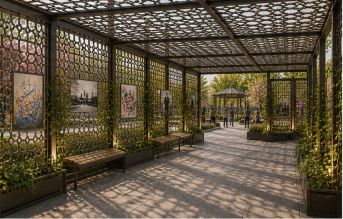
In my proposed design for the Persian Garden, I incorporated
latticed walls (windows of transparency), which are
both a nod to our heritage and a symbol of openness.
Personally, I try to embody that same transparency by
maintaining a non-partisan, balanced presence across all
Willowdale groups on social media.
The Mask
I could not believe that I would once again hear the phrase
"go back to your country" uttered by one of my neighbours—someone
I have never met and with whom I share no prior animosity.
The first time I heard this
phrase
was in January 2015 from the mouth of a Chinese-Canadian
politician, the then-Conservative MP for Willowdale in the
Canadian Parliament, Chungsen Leung. Hearing it today from
an ordinary citizen, and a woman at that—in whose eyes I
have always sought hope for a better future for the entire
world—was profoundly sadder.
I do not believe this individual would ever speak to me this
way in a face-to-face encounter. The digital realm grants us
a false audacity, nurturing a side of our nature that would
have been better left in the dark. The Persian Garden, as a
physical space operating in tandem with social media, can be
a catalyst that allows our pleasant, humane, and brighter
sides to flourish instead.
Freedom of Speech and Transparency
It is not, and will not be, surprising that we hold
differing definitions and understandings of democracy,
freedom of speech, legality, and public versus private
spheres. However, what remains undeniable—and cannot be
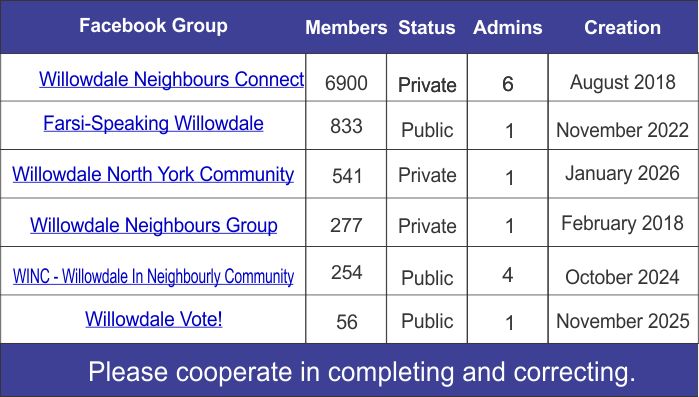
altered by justification—are our actions. Why should a local
Facebook neighbourhood group with nearly 7,000 members
maintain a "Private" status?
Of course, we can only raise such questions once a group has
successfully cultivated a "sense of belonging" within
us. Otherwise, if administrators view these groups as their
personal private property, raising these issues becomes
irrelevant. A sense of belonging creates both rights and
responsibilities, and it stands as a marker of
collective success.
Accusations of Spying and the Sin of Allyship
What puzzles me above all else are the accusations of
"spying," the blocking of neighbours from joining, and
particularly the public glorification of these bans and
exclusions in a digital space that carries our
neighbourhood's name. Without a doubt, such behaviours are
only possible in a closed environment defined by high walls,
tribalism, and cliquish dynamics.
Is such an intense sensitivity to democracy surprising
coming from someone who has fled tyranny? There are
countless other points to address, which I will expand upon
in the future. I have prepared this article in two
languages, keeping both my Iranian and non-Iranian readers
in mind.
In closing, I request the administrators of our local groups
to activate the "Post Approval" option for my content rather
than resorting to deletion or blocking. Let us ensure that
the sacred space of community dialogue in our neighbourhood
is never stained by censorship. |